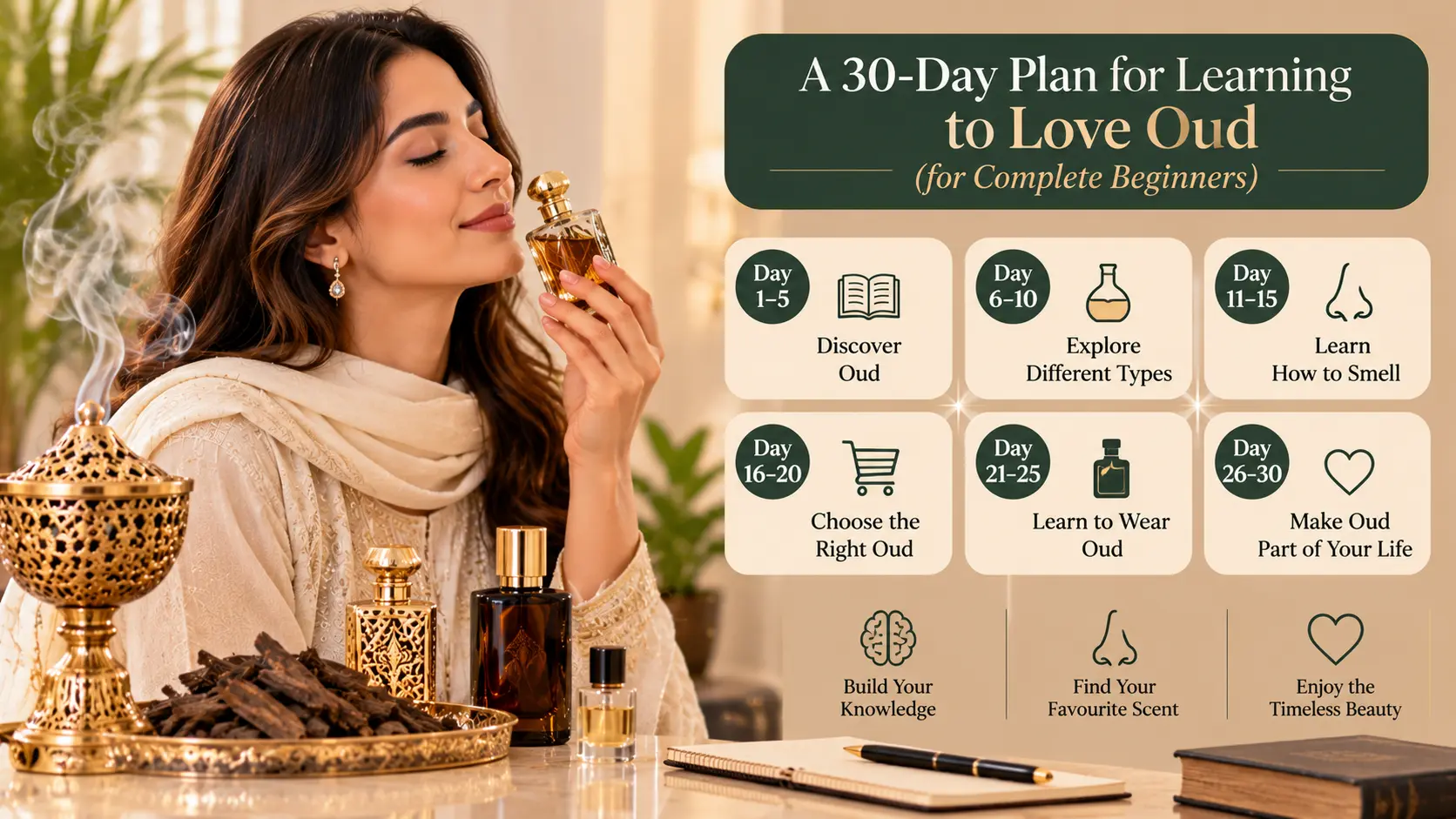
| Oud is often an acquired taste, so it helps to ease in slowly. Over 30 days, start by smelling oud on paper and in soft blends. Then wear light, sweet oud fragrances in small amounts. Move on to richer, smokier blends, and finally choose a signature scent. Use one or two sprays at first, test on skin and give each fragrance a full day. Many people who dislike oud at first find they enjoy it once their nose gets used to it. |
Your first smell of oud might not be love at first sniff. Some people find it smoky, woody or even a little sharp. Others notice a leathery, animalic edge they didn’t expect.
That’s completely normal. Oud is one of the most complex materials in perfumery. For many people, it’s an acquired taste, like strong coffee or dark chocolate. The good news is that you can train your nose to enjoy it.
This 30-day plan takes you from first sniff to signature scent, one small step at a time.
Why Oud Takes Time to Love
Most Western fragrances are built around fresh, floral, fruity or sweet notes. Oud is different. It can be:
- Smoky, like incense or a wood fire
- Woody and deep
- Leathery or slightly animalic
- Resinous, rich and warm
If you’ve never smelled anything like it, your brain doesn’t know where to file it yet. Many unfamiliar smells feel strange at first and become more pleasant as they grow familiar.
Oud also changes a lot on the skin. The opening can be bold, but the dry-down is often smoother, softer and warmer. Learning to love oud is partly about learning to wait for that change.
Before You Start
A few simple rules make the plan easier:
- Start small. One spray is enough at first. Oud is often strong and long-lasting.
- Test on skin. Paper is useful for first impressions, but oud only shows its full character on warm skin.
- Give it time. Judge a fragrance after a few hours, not the first few seconds.
- Take notes. Write down what you smell and how you feel about it.
- Rest your nose. Your nose gets used to a scent quickly, so smell something else or step outside between tests.
Week 1: Get to Know Oud (Days 1–7)
This week is about smelling, not wearing. The aim is simply to get familiar.
Days 1–2: First impressions. Spray a few oud fragrances on paper strips or card. Smell each one, then put it down. Come back after 10 minutes, then after an hour. Notice how the scent softens.
Days 3–4: Find the words. Try to describe what you smell. Is it smoky, sweet, woody, spicy, leathery or floral? There are no wrong answers. Naming the notes helps your brain make sense of them.
Days 5–7: Spot the blends. Compare oud fragrances paired with different notes. Oud with rose smells very different from oud with vanilla, amber or spice. Note which pairings feel easiest to enjoy.
By the end of week 1: You should know which styles you like best and which feel too strong for now.
Week 2: Start With Soft Blends (Days 8–14)
Now it’s time to wear oud, but gently.
Days 8–10: One spray, low-key days. Choose the softest oud blend from week 1, such as oud with rose, vanilla or amber. Apply one spray to your wrist or inner elbow on a relaxed day at home.
Days 11–12: Follow the dry-down. Smell your skin every hour or two. Notice how the opening changes into the heart and then the base.
Days 13–14: Wear it out. Wear your soft blend for a short outing, such as a coffee or a walk. Pay attention to how it feels to carry the scent with you.
By the end of week 2: Oud should feel less surprising, and you may start to enjoy the warm, cosy dry-down.
Week 3: Explore Deeper Oud (Days 15–21)
Your nose is now more familiar with oud. This week, you’ll try richer and smokier styles.
Days 15–17: Step up the intensity. Try a fragrance where oud plays a bigger role, perhaps with smoky, woody or leathery notes. Keep to one or two sprays.
Days 18–19: Try different times. Wear oud in the evening or on cooler days. Many people find rich ouds feel most at home after dark or in colder weather.
Days 20–21: Compare and reflect. Wear your soft blend one day and a richer oud the next. Note which you reach for and why.
By the end of week 3: You’ll likely have a clearer sense of whether you prefer soft, sweet ouds or deeper, smokier ones.
Week 4: Find Your Signature Oud (Days 22–30)
Now it’s time to choose a favourite.
Days 22–25: Shortlist. Pick two or three fragrances you enjoyed most. Wear each one for a full day.
Days 26–28: Real-life test. Wear your shortlisted fragrances to work, dinner or social plans. Notice how you feel, and whether others comment.
Days 29–30: Decide. Choose the one that makes you feel most like yourself. That’s your signature oud, for now. Your taste may keep changing as your nose grows more confident.
By the end of week 4: You’ll have gone from first sniff to a fragrance you actually love wearing.
Your 30-Day Oud Plan at a Glance
| Week | Focus | What to do |
| Week 1 (Days 1–7) | Get familiar | Smell oud on paper, describe the notes, compare blends |
| Week 2 (Days 8–14) | Wear soft blends | One spray of a light oud blend at home, then on short outings |
| Week 3 (Days 15–21) | Go deeper | Try richer, smokier ouds, in the evening or cooler weather |
| Week 4 (Days 22–30) | Choose a signature | Shortlist two or three, wear them in real life, pick a favourite |
Beginner-Friendly Oud Pairings
If raw oud feels too much, start with blends that soften its edges:
- Oud and rose. A classic Middle Eastern pairing. The rose adds softness and a floral lift.
- Oud and vanilla. Sweet, creamy and comforting. A gentle way into oud.
- Oud and amber. Warm and glowing, with a rounded, cosy feel.
- Oud and saffron. Slightly spicy and leathery, for when you’re ready for more depth.
- Oud and sandalwood. Smooth, creamy and woody.
Common Beginner Mistakes
- Spraying too much. Oud is powerful. Too much can overwhelm you and everyone around you.
- Judging too fast. The opening is often the boldest part. Wait for the dry-down.
- Testing only on paper. Oud needs skin warmth to show its full character.
- Starting with the strongest oud. Begin with soft blends and build up.
- Testing too many at once. Your nose gets tired quickly. Stick to two or three fragrances a day.
What If You Still Don’t Love It?
That’s fine too. Not every fragrance suits every person, and taste is personal.
You might find you enjoy oud as a supporting note rather than the star. Or you may like it only in colder months or for evenings. Some people come back to oud months later and find it suddenly clicks.
The aim of this plan isn’t to force a love of oud. It’s to give it a fair chance.
Start Your Oud Journey With Emiri Oud
Ready to begin? Explore the Sheikh collection of men’s oud perfumes or the Sheikha collection for women. Find a starting point that suits you.
Not sure which fragrance is right for a beginner? Contact the Emiri Oud team and we’ll help you choose.
Frequently Asked Questions
Why don’t I like the smell of oud?
Oud can smell smoky, woody, leathery or animalic, which is very different from most Western perfumes. Unfamiliar smells often feel strange at first. Many people grow to enjoy oud as their nose gets used to it.
Is oud an acquired taste?
For many people, yes. Oud is complex and often bold. Start with soft blends, such as oud with rose or vanilla. Then build up slowly to help you learn to enjoy it.
What is the best oud for beginners?
Look for oud blended with softer notes, such as rose, vanilla, amber or sandalwood. These blends smooth oud’s smoky edges and are easier to enjoy at first.
How much oud perfume should a beginner wear?
Start with one spray on your wrist or inner elbow. Oud is often strong and long-lasting, so a little goes a long way. You can add more once you know how it wears on you.
How long does it take to get used to oud?
It varies from person to person. Smelling and wearing oud regularly, in small amounts, for a few weeks helps many people get used to it. This 30-day plan gives your nose time to adjust.
Why does oud smell different after a few hours?
Perfume changes as it dries. The opening notes fade first, then the heart and base notes come through. Oud often turns smoother, warmer and softer in the dry-down.