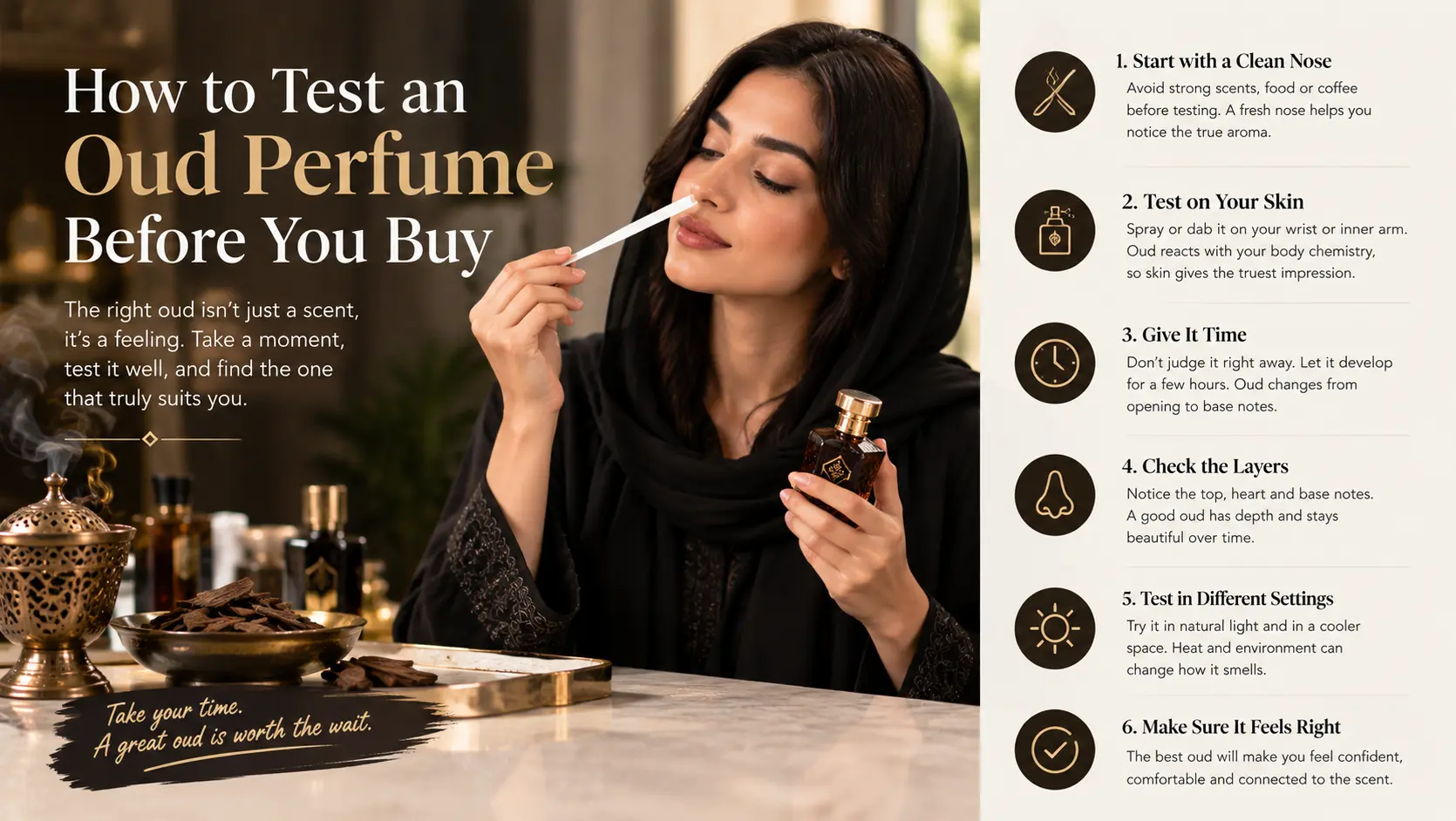
| Never judge an oud perfume from the bottle or a paper strip alone. Spray it on clean, unscented skin, then wear it for a full 24 hours before you decide. Oud changes more than most fragrances: the opening can be smoky or sharp, while the heart and base often turn warm and smooth hours later. Test one or two scents at a time and note how long they last. If you can, buy a sample or travel size first. |
Oud is one of the most rewarding notes in perfumery, and one of the easiest to misjudge. A quick spray in a busy shop can smell harsh, medicinal or overwhelming. Wait a few hours, and the same fragrance might become the warm, rich scent you can’t stop smelling on your wrist.
That’s why testing oud properly matters, especially when you’re investing in a full bottle. Here’s how to do it, step by step.
Why Oud Needs a Different Approach
Oud comes from agarwood, the dark, fragrant resin that forms inside Aquilaria trees. Its scent is deep, woody and complex. Depending on the blend, it can lean smoky, leathery, sweet, earthy or even slightly animalic.
Most fragrances change as they dry down, but oud tends to change more dramatically. The first few minutes rarely tell you how it will smell an hour later. Judging it too early is the most common reason people dismiss a perfume they would have loved.
Understand How an Oud Perfume Unfolds
Every perfume develops in three broad stages:
- Top notes (first 5–15 minutes): The brightest, most noticeable part. In oud perfumes, this can include citrus, spice or a sharp, smoky edge.
- Heart notes (about 30 minutes to a few hours): The core character appears. Rose, saffron and florals often show up here alongside the oud.
- Base notes (several hours onwards): The deepest, longest-lasting layer. Oud, amber, sandalwood, musk and vanilla settle onto the skin.
With oud, the base is often where the magic happens. That’s why patience is part of the test.
Step 1: Start With a Sample, Not a Full Bottle
A sample or small travel size lets you live with a fragrance before committing. You can wear it on different days, in different weather and in different settings.
No samples on offer? Ask whether the brand has a smaller size, or can advise you based on scents you already love. Be wary of cheap “decants” from unknown sellers, as you can’t be sure what’s inside.
Step 2: Prepare Your Skin
Testing on skin tells you far more than testing on paper. Your body heat, natural oils and skin type all shape how a scent develops.
- Test on clean, dry skin with no other fragrance on it.
- Avoid scented moisturisers, body sprays or deodorants near the test area.
- If your skin is very dry, apply a little unscented moisturiser first. Dry skin tends to let fragrance fade faster.
Step 3: Apply It the Right Way
- Spray once on the inner wrist or inner elbow, from about 10–15 cm away.
- Let it dry naturally. Don’t rub your wrists together, as this warms the skin and can change how the top notes come through.
- Use a paper strip only for a first impression, or to compare several scents in a shop.
- If you’re testing two fragrances, use one on each arm and label them so you don’t mix them up.
Step 4: Test No More Than Two or Three at Once
Your nose tires quickly, especially with rich, heavy notes like oud. After a few scents, everything starts to smell the same.
Limit yourself to two or three fragrances per session. Between sniffs, step outside for fresh air or smell a patch of your own unscented skin to reset. Many people sniff coffee beans to clear their nose, but fresh air and a short break work just as well.
Step 5: Follow the 24-Hour Rule
The 24-hour rule is simple: wear the fragrance for a full day before deciding to buy. It’s the single best way to avoid an expensive mistake.
Over those 24 hours, you’ll learn:
- How it opens and dries down: whether you like the scent at every stage, not just the first spray.
- How long it lasts: a good eau de parfum should still be noticeable several hours later.
- How far it projects: whether it stays close to your skin or fills a room.
- How it reacts with your skin: the same perfume can smell different on different people.
- How you feel wearing it: whether it suits your daily life, or only special occasions.
The 24 hours also give you time to notice any skin irritation. If you have sensitive skin or a history of reactions to fragrance, a small test patch is especially sensible.
Step 6: Keep Simple Notes
When you’re testing several oud perfumes over a week or two, the details blur. A few quick notes on your phone make the decision much easier:
| What to note | Example |
| Time applied | 9:00 am |
| First impression | Smoky, slightly sharp, saffron |
| After 1 hour | Softer, rose and warm wood |
| After 4–6 hours | Amber and oud, close to the skin |
| Still noticeable at | 8–9 hours |
| Compliments or comments | Two people asked what I was wearing |
| Overall feeling | Love the dry-down, too strong for the office |
Step 7: Test in Real-Life Conditions
Fragrance behaves differently with temperature. On a cold UK day, an oud perfume may sit quietly close to the skin. In a warm office or on a summer evening, it can bloom and project much further.
If you can, wear your sample in the setting where you’ll use it most, whether that’s work, evenings out or special occasions. Something that feels perfect for a winter night out may be too much for a meeting room.
Common Mistakes When Testing Oud
- Judging the perfume in the first five minutes.
- Smelling it straight from the nozzle or the bottle neck.
- Testing too many fragrances in one visit.
- Relying only on a paper strip.
- Testing over another perfume, lotion or body spray.
- Buying a full bottle based on someone else’s review alone.
Ready to Find Your Signature Oud?
Once you know how a fragrance behaves on your skin over a full day, choosing becomes much easier. Explore Emiri Oud’s men’s oud perfumes in the Sheikh collection, or discover the women’s Sheikha collection. Each blends authentic oud with notes such as saffron, rose, amber and musk.
Not sure where to start? Get in touch with the Emiri Oud team, tell us the scents you already love, and we’ll help you find the right match.
Frequently Asked Questions
How long should I test an oud perfume before buying?
Wear it for a full 24 hours. Oud perfumes change a lot as they dry down. The opening rarely reflects how the fragrance will smell after a few hours. A full day shows you the dry-down, longevity, projection and how it suits your skin.
Should I test oud perfume on skin or on a paper strip?
Use a paper strip only for a first impression. Skin gives a much truer picture. Your body heat and natural oils change how the fragrance develops and how long it lasts.
Why does oud smell different on my skin than on someone else’s?
Skin type, natural oils, body temperature and even diet can affect how a fragrance smells and lasts. Dry skin tends to let scent fade faster, while oilier skin often holds it longer.
Should I rub perfume into my wrists?
It’s best not to. Rubbing warms the skin and can change how the top notes come through. Spray once, then let the fragrance dry naturally.
How many perfumes can I test at once?
Two or three at most. Your sense of smell tires quickly, especially with rich notes like oud. Take breaks in fresh air between scents to reset your nose.
What is the 24-hour rule for perfume?
The 24-hour rule means wearing a fragrance for a full day before you buy it. It lets you judge every stage of the scent, how long it lasts and whether it causes any skin irritation.