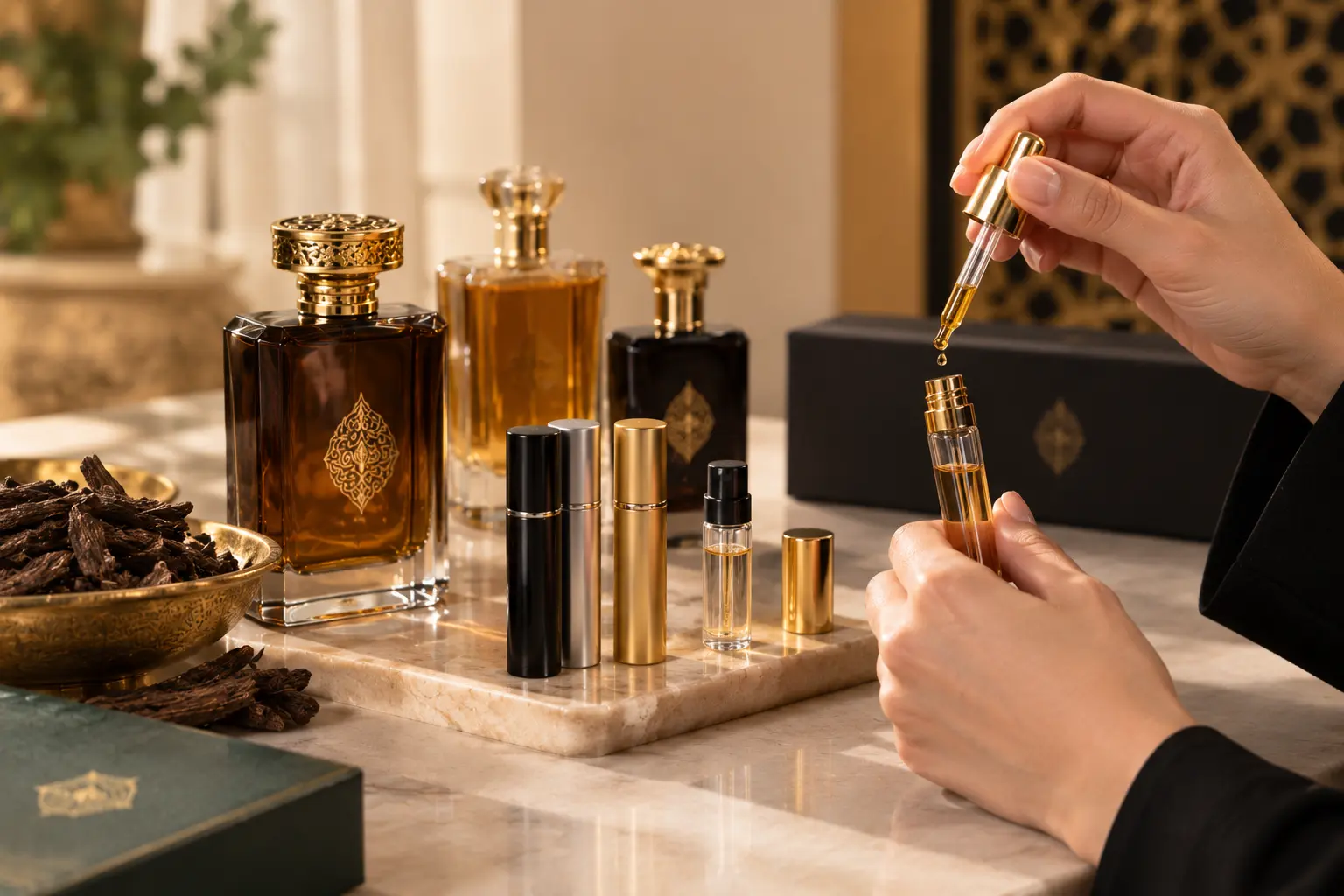
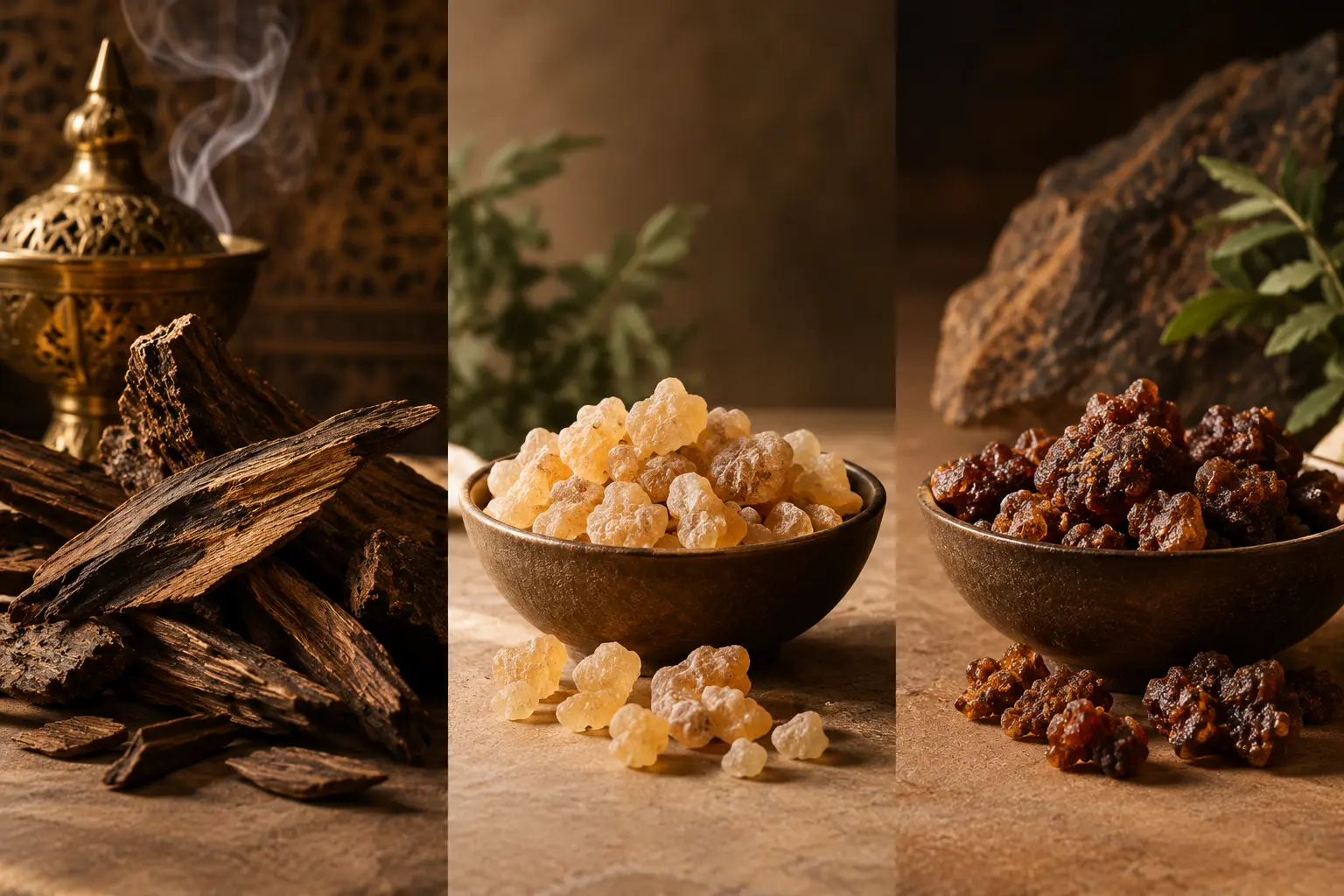
| Oud, frankincense and myrrh are all prized resin fragrances, but they come from different trees and smell quite different. Oud is a dark resin that forms inside Aquilaria wood after the tree is wounded and infected. Frankincense and myrrh are gum resins that ooze from cuts in the bark of Boswellia and Commiphora trees. Oud smells smoky, woody and rich. Frankincense smells fresh, peppery and incense-like. Myrrh smells warm, bitter and balsamic. Oud is usually the rarest and most costly of the three. |
Oud, frankincense and myrrh have been treasured for thousands of years. All three are burned as incense, used in perfume and linked with ritual, celebration and luxury.
Because they’re often grouped together, it’s easy to assume they smell alike. They don’t. Each has its own source, character and place in a fragrance. Here’s how they compare, and how to choose between them.
What Makes a Fragrance a Resin Fragrance?
A resin is a thick, sticky substance that some trees produce, often to protect themselves from damage. Many resins are richly scented. When they’re burned, distilled or blended into perfume, they give a warm, deep and long-lasting effect.
In perfumery, resins usually sit in the base of a fragrance. They add depth, warmth and staying power.
Oud, frankincense and myrrh all fit this family. But oud forms in a very different way from the other two.
What Is Oud?
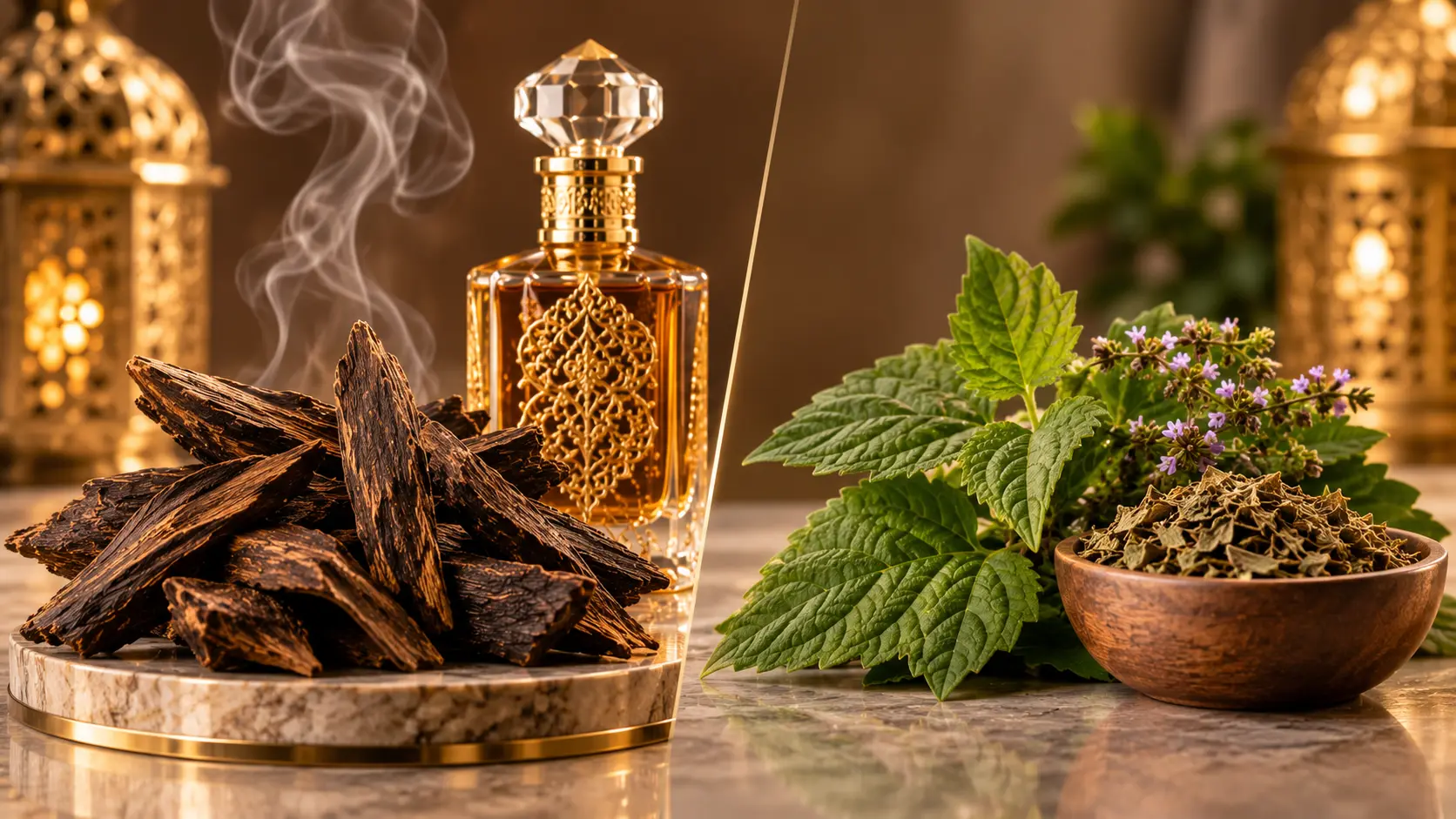
Oud, also called agarwood, comes from Aquilaria trees in South and Southeast Asia. The wood of a healthy tree is pale and has little scent.
When the tree is wounded, often by insects, a mould can infect it. The tree responds by filling its heartwood with a dark, fragrant resin. That resin-soaked wood is oud.
Unlike frankincense and myrrh, oud isn’t collected as drops of resin from the bark. The resin builds up inside the wood itself. The wood is then burned as incense chips or distilled into oud oil.
Only a small share of wild trees produce this resin. All Aquilaria species are also protected under CITES, the international treaty on trade in endangered species. This is why real oud is so rare and so highly valued.
What Is Frankincense?
Frankincense comes from Boswellia trees. They grow in hot, dry regions of Arabia, the Horn of Africa and India. The most famous species, Boswellia sacra, grows in Oman, Somalia and southern Arabia.
To collect it, harvesters cut the bark. The tree releases a milky resin that slowly hardens into pale tears. These are sorted by hand, then burned as incense or steam distilled into an oil.
Oman’s frankincense heritage is so important that UNESCO lists the Land of Frankincense as a World Heritage Site.
What Is Myrrh?
Myrrh comes from Commiphora trees, which belong to the same plant family as frankincense. The best-known species, Commiphora myrrha, grows in Somalia, Ethiopia, Eritrea, Yemen, Oman and parts of Saudi Arabia.
Like frankincense, myrrh is collected by cutting the bark. The tree bleeds a resin that hardens into reddish-brown pieces. The name myrrh comes from an ancient word meaning “bitter”.
Myrrh has a long history. Ancient Egyptians used it, and it’s famous as one of the three gifts of the Magi.
How Do They Smell?
Oud
Oud is the boldest of the three. Depending on its source and quality, it can smell:
- Smoky and woody
- Rich and resinous
- Leathery or animalic
- Sweet, with hints of fruit or honey in some oils
Frankincense
Frankincense is the brightest and freshest. It’s often described as:
- Fresh, with a lemony or piney lift
- Peppery and slightly spicy
- Clean and incense-like
- Woody and resinous
Myrrh
Myrrh is the warmest and most mysterious. It can smell:
- Warm and balsamic
- Slightly bitter
- Earthy, with a hint of mushroom
- Smoky-sweet when burned
Oud vs Frankincense vs Myrrh at a Glance
| Feature | Oud | Frankincense | Myrrh |
| Tree | Aquilaria | Boswellia | Commiphora |
| How it forms | Resin builds up inside infected wood | Resin flows from cuts in the bark | Resin flows from cuts in the bark |
| Main regions | South and Southeast Asia | Arabia, Horn of Africa, India | Arabia and Horn of Africa |
| Scent | Smoky, woody, rich, leathery | Fresh, peppery, citrusy, incense-like | Warm, bitter, balsamic, earthy |
| Mood | Deep and luxurious | Bright and uplifting | Warm and mysterious |
| Rarity | Rare; trees protected under CITES | More widely available | More widely available |
Why Oud Is Usually the Most Costly
All three resins take time and skill to produce. But oud is usually far more expensive. That comes down to how it forms.
- Oud relies on infection. A tree has to be wounded and infected, then build up resin over many years.
- Few trees produce it. In the wild, only a small share of Aquilaria trees form oud at all.
- Trade is controlled. All Aquilaria species are listed under CITES.
- Frankincense and myrrh can be tapped. Harvesters collect them from living trees, often several times a year.
Because real oud is so rare, many perfumes use an oud accord. This is a blend of other materials that recreates the oud effect. It’s a normal part of perfumery.
How Perfumers Use Them Together
Oud, frankincense and myrrh are natural partners. You’ll often see two or all three on the same notes list.
- Frankincense lifts oud. Its fresh, peppery opening brightens oud’s dark depth.
- Myrrh adds warmth. Its balsamic sweetness smooths oud’s smoky edges.
- Together they build an incense style. The blend can feel warm, smoky and spiritual.
- They suit rose and amber. All three pair well with classic Middle Eastern notes.
They also come together in bakhoor, the scented wood chips burned across the Middle East. Bakhoor often blends oud with resins, oils and other fragrant materials.
Which Resin Fragrance Should You Choose?
Each resin suits a different mood.
You may prefer oud if you like:
- Rich, smoky and luxurious scents
- Fragrances with a strong presence
- Traditional Middle Eastern perfume styles
Someone may prefer frankincense if they like:
- Clean, fresh and uplifting scents
- Light incense notes
- Fragrances that feel calm and airy
You may prefer myrrh if you like:
- Warm, sweet and comforting scents
- Softer, smoother incense notes
- Fragrances with a mysterious edge
Can’t decide? A fragrance that blends oud with frankincense or myrrh gives you depth, freshness and warmth in one.
How to Test Resin Fragrances
- Test on skin. Resins change with body heat, so paper only tells half the story.
- Wait for the dry-down. Resin notes show most clearly after 30 minutes or more.
- Notice the opening. A fresh, peppery start often points to frankincense.
- Notice the base. Smoky depth suggests oud, while warm bitterness suggests myrrh.
- Wear it for a full day. Resin fragrances often change slowly over many hours.
Discover Oud at Emiri Oud
Oud is the richest and rarest of the resin fragrances, and the best way to understand it is to wear it. Explore the Sheikh collection of men’s oud perfumes or the Sheikha collection for women.
Not sure where to start? Contact the Emiri Oud team and we’ll help you find your scent.
Frequently Asked Questions
What is the difference between oud, frankincense and myrrh?
Oud forms inside the wood of infected Aquilaria trees. Frankincense and myrrh are resins that flow from cuts in the bark of Boswellia and Commiphora trees. Oud smells smoky and rich, frankincense fresh and peppery, and myrrh warm and bitter.
Is oud a resin?
Yes, in a way. Oud is wood that has filled with a dark, fragrant resin after the tree was wounded and infected. Unlike frankincense and myrrh, the resin isn’t collected from the bark. It builds up inside the wood.
Which is more expensive, oud or frankincense?
Oud is usually far more expensive. It forms slowly, only a small share of trees produce it and all Aquilaria species are protected under CITES. Frankincense and myrrh can be tapped from living trees.
What does myrrh smell like?
Myrrh smells warm, balsamic and slightly bitter, with an earthy edge. When burned, it can smell smoky and sweet. Its name comes from an ancient word meaning “bitter”.
Do oud and frankincense go well together?
Yes. Frankincense adds a fresh, peppery lift that brightens oud’s smoky depth. The pair is popular in incense-style and Middle Eastern fragrances.
Are frankincense and myrrh from the same tree?
No, but they’re related. Frankincense comes from Boswellia trees and myrrh from Commiphora trees. Both belong to the same plant family, Burseraceae.