
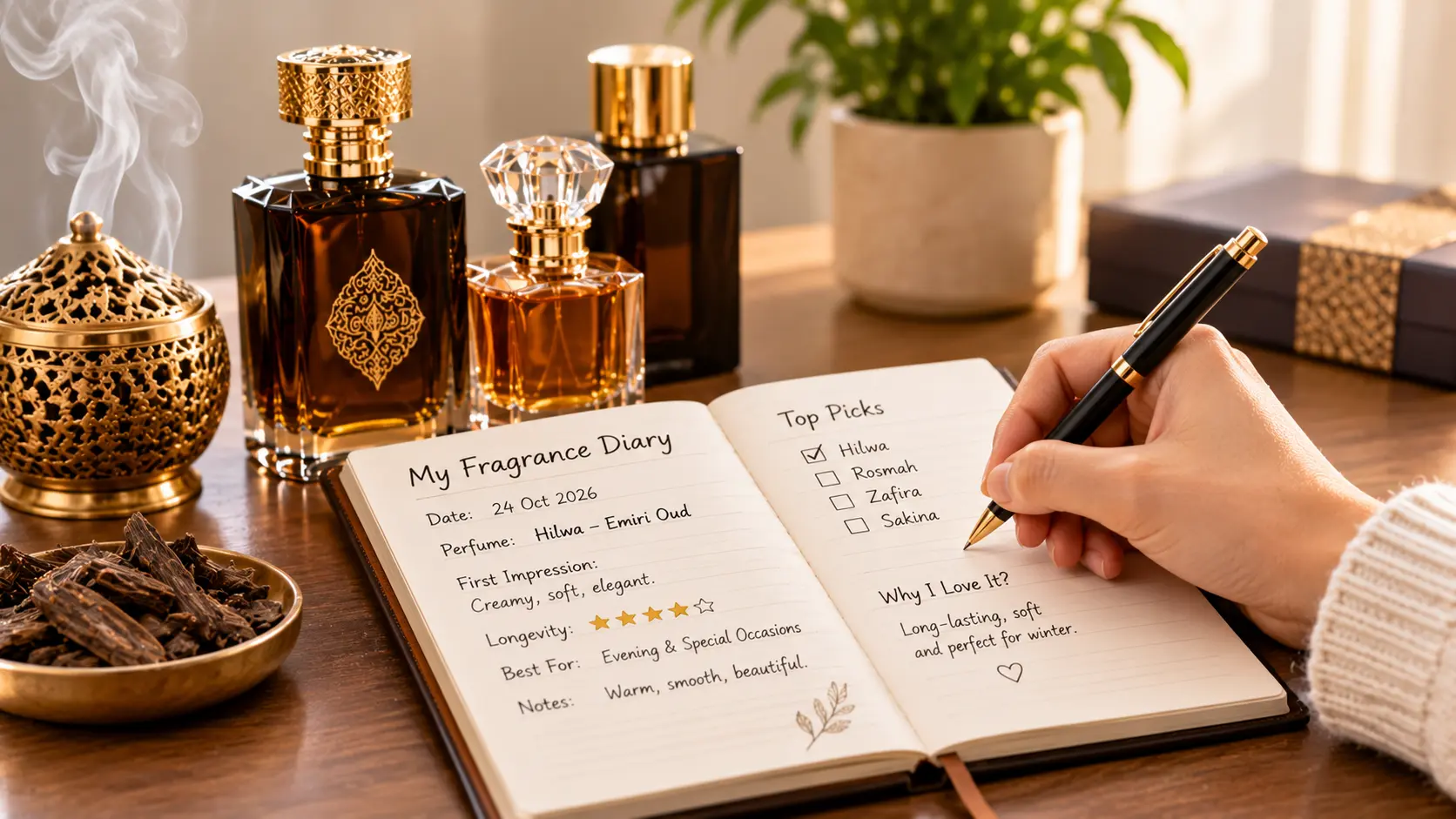
Oud is a scent that rewards patience, because it changes as it warms on your skin, it smells different from one person to the next, and it can feel sharp in the first ten minutes and glorious three hours later. That makes it easy to forget what you really thought of a perfume by the time you get home, and a fragrance diary solves this problem. It is a simple record of what you wore, how it smelled and how you felt, and over time it shows you exactly which ouds you love, so here is how to start one.
Why a Fragrance Diary Helps
When you smell many perfumes, memory is unreliable, because scents blur together and the one you tried first in a shop is often forgotten by the time you try the fifth. A diary gives you something to look back on, and that helps in several ways. It stops you buying a bottle on impulse that you did not enjoy after the first hour. It helps you spot patterns in what you like, such as smoky woods, soft florals or sweeter amber. And it gives you the right words to describe your taste when you ask for advice or choose a gift. If you are still learning what makes oud special, our guide to what makes a perfume an oud is a helpful starting point.
What You Need
You do not need anything fancy, since a small notebook works well, and so does a notes app on your phone or a simple spreadsheet. The best tool is the one you will actually use, so pick whichever is easiest to reach when you are trying a scent. Some people like to keep a few blank paper cards or scent strips too, so they can stick a note beside the strip.
What to Write Down
For each perfume, record a few simple details, starting with the name, the date and where you tried it. Add the notes listed by the brand, such as the top, heart and base, since these give you words to compare later, and then note how you applied it, including how many sprays and where, because amount and placement change the result. It also helps to record the weather and your mood, as warm rooms and cold air can change how a scent feels.
Record How It Changes Over Time
The most useful part of the diary is what happens over time. Write down your first impression in the opening minutes, then your impression after about an hour, and then again after a few hours. Oud often opens sharp, smoky or medicinal before it softens into something rounder, so the later stages are where you decide whether you really love it. Finish by noting how long it lasted and whether you got any compliments or comments, since other people’s reactions can tell you how far it travelled.
Find Your Own Words
You can use simple words rather than fancy ones, so try describing a scent as smoky, sweet, woody, creamy, floral, spicy, resinous, leathery, clean or heavy. If a word does not come, compare it to something real, such as a campfire, a cedar chest, warm honey or a leather jacket. There are no wrong answers, because the diary is for you.
Add a Score
It helps to add a short score too, and a simple mark out of five for how much you enjoyed it, plus a separate note on whether you would wear it again, is enough. Keep the score honest, because a scent can be impressive and still not be one you want to wear, and the diary will show you that difference.
An Example Entry
Here is an example entry to show how it might look, using one perfume from our range. Velvet Rose lists pineapple at the top, rose at the heart and oud with musk in the base. In your diary, you might write the date, the place and the number of sprays, followed by the listed notes. Then you add your own impressions at the ten-minute, one-hour and four-hour marks, how long it lasted, a score out of five and whether you would buy it. Your impressions will be your own, because the same perfume can smell different on every person.
Keep the Conditions the Same
Try to keep the conditions the same when you compare scents. Test on clean, unscented skin, and try only one or two perfumes in a day so your nose does not tire. Wear each one for a full day if you can, since the base notes only appear after a few hours. If you are trying several scents, put one on each arm and note the results separately. Our guide to how many sprays of oud perfume to use will help you keep the amount consistent, which makes your notes easier to compare.
Look for Patterns
After a few weeks, review what you have written and look for words that keep appearing in your favourite entries, and words that appear in the ones you disliked. You may find that you love creamy, soft ouds and dislike sharp, animalic ones, or that you enjoy spice but not sweetness. Our guide to Indian, Cambodian and Thai oud can help you connect your notes to the different styles of oud. Once the pattern is clear, shopping becomes far easier, because you know what to look for. You can also use the diary to plan a collection, which is the idea behind our guide to building a fragrance wardrobe around oud.
Mistakes to Avoid
A few mistakes are worth avoiding, so do not judge a scent only in the first few minutes, because oud often changes a lot. Do not test too many perfumes at once, since your nose will tire and everything will start to smell the same. Do not skip writing things down on the day, because memories fade quickly. And do not worry about being a good writer, since a few honest words are more useful than a long, polished review.
Use the Diary to Look After Your Collection
Your diary can also help you look after your collection, because you can note when you bought each bottle and how it smells months later, which is useful for storage and for spotting changes. Our guide to how to store oud perfume so it lasts longer explains how to keep it at its best.
Frequently Asked Questions
What should I write in a fragrance diary?
Record the name, the date, the notes and how many sprays you used. Then add your impressions at the start, after an hour and after several hours, plus how long it lasted and a score.
How long should I wear an oud before deciding?
Give it at least a few hours, and a full day if you can, because oud changes as it warms on your skin, and the later stages are often the best.
Do I need to be good at describing scent?
No, because simple words and comparisons to things you know are enough, and your own descriptions will become richer with practice.
How many perfumes should I test in one day?
One or two is best, since more than that tires your nose, so the scents blur together and your notes become less reliable.
Final Thoughts
A fragrance diary turns a vague feeling into clear knowledge about your taste. Write a few honest notes each time you try an oud, review them after a few weeks and let the patterns guide you to the scents you really love. You can explore our range in the shop when you are ready to add your next entry.